
Positioning for Leverage
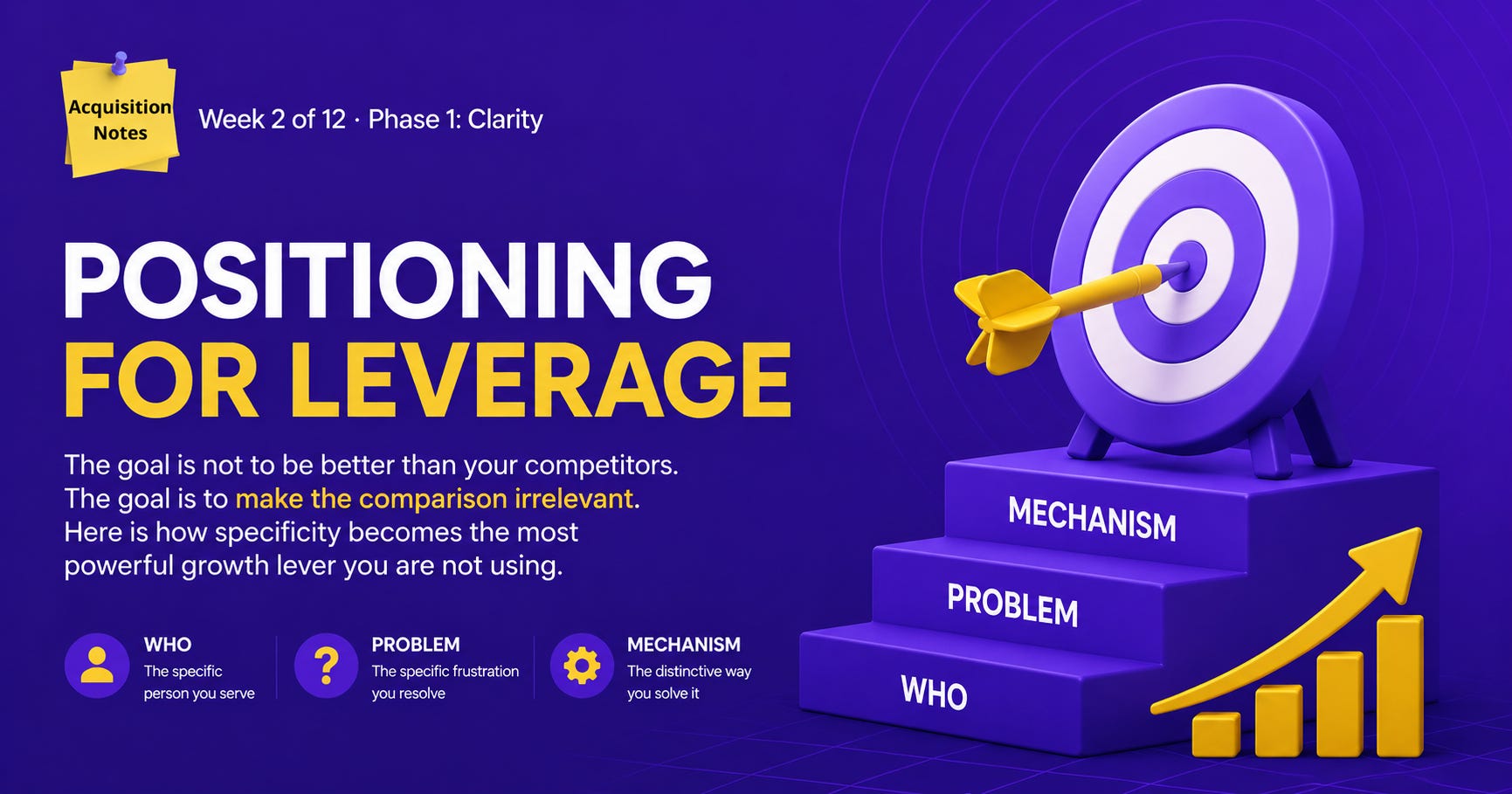
The goal is not to be better than your competitors. The goal is to make the comparison irrelevant. Here is how specificity becomes the most powerful growth lever you are not using.
Week 2 of 12 · Phase 1: Clarity
Written by Samuel Valente
Week 1 recap: You wrote your One Offer Statement and ran your offers through the Three-Part Filter. This week, we take that offer and make it impossible to ignore.
There is a question that surfaces in almost every sales conversation a founder has, and almost every founder answers it badly.
“What makes you different from the other options out there?”
The typical response involves some combination of experience, quality, results, and genuine commitment to the work. The founder means every word of it. And the prospect has heard every word of it from the last three people they spoke to before this conversation.
Not because the founder is lying. But because they are competing on the wrong dimension entirely.
Competing on differentiation assumes that the prospect is running a comparison, evaluating you against alternatives, weighing features and credentials and track records, looking for the option that scores highest. And if you accept that frame, you are already in a weaker position than you need to be.
Because someone will always be cheaper.
Someone will always have more testimonials.
Someone will always have been doing this for longer.
The goal of positioning is not to win the comparison. The goal is to step so far into specificity that the comparison stops being relevant.
When your positioning is sharp enough, the right prospect does not evaluate you against alternatives. They recognize themselves in what you have described, and they move toward a decision because they have not seen anything that addresses their specific situation this precisely before.
That recognition is what positioning is actually for. And it is built through one thing: getting specific enough to matter deeply to someone, rather than remaining broadly relevant to everyone.
The story that changed how I think about this
Consider what happens when a business shifts from speaking to a broad category to speaking to a specific type of person within it.
Imagine a consultant who works with fitness businesses.
For a long time, they position themselves as a “business coach for health and wellness entrepreneurs.” The message reaches personal trainers, gym owners, nutritionists, online coaches, and wellness studios equally. It converts inconsistently, because none of those groups feel specifically addressed.
Then they make one decision: they stop speaking to everyone in fitness and start speaking exclusively to gym owners. Same knowledge. Same frameworks. Same results. Different specificity.
The message changes from “I help health and wellness businesses grow” to “I help gym owners build acquisition systems that fill their schedule without relying on word of mouth or discounts.” Every piece of content, every case study, every conversation now speaks directly to one type of person’s specific problem.
The conversion rate does not double. It multiplies. Not because a new tactic was introduced, but because the right person now reads the message and thinks: “This is written for me.” That feeling (of being precisely understood) is more persuasive than any sales technique ever invented.
Specificity is not a limitation on who you can serve. It is the condition under which the right people can find you, recognize themselves, and decide without hesitation.
