
The Phase 1 Review
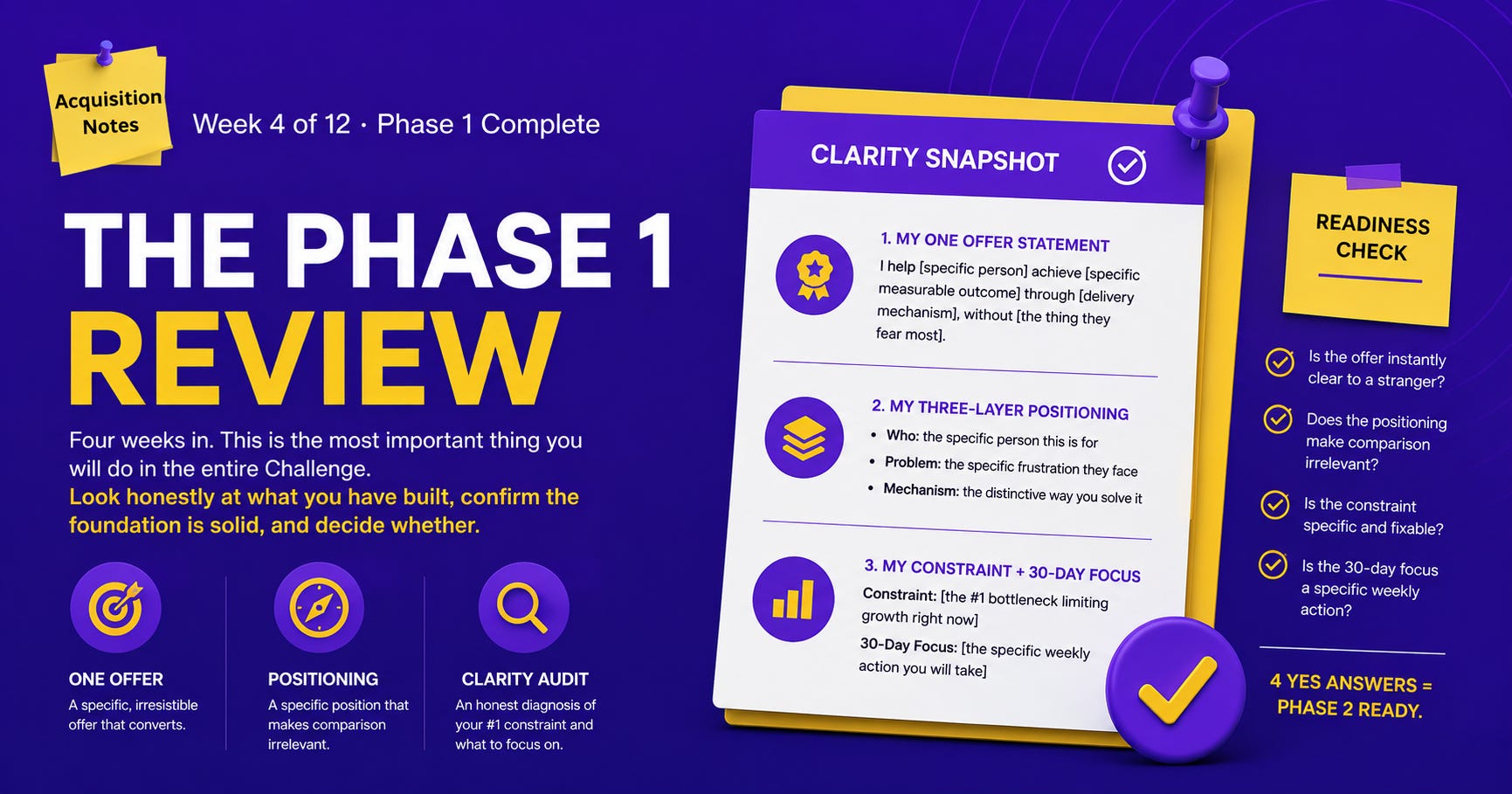
Four weeks in. No new framework this week, just the most important thing you will do in the entire Challenge: look honestly at what you have built, confirm the foundation is solid, and decide whether
Week 4 of 12 · Phase 1 Complete
Phase 1 recap:
Week 1 gave you the One Offer Rule.
Week 2 gave you Positioning for Leverage.
Week 3 gave you the Clarity Audit.This week assembles all three into the Clarity Snapshot, your single reference document before Phase 2 begins.
There is a temptation at this point in any structured programme to skip the review and move straight to the next thing. The next framework. The next concept. The next week of forward motion.
Resist it.
The Phase 1 Review is not a pause in the Challenge. It is the most important work of the entire first month, because it is the first moment where you stop building and start looking honestly at what you have built. And that honesty, applied carefully before Phase 2 begins, is what determines whether the next eight weeks compound or collapse.
Most structured programmes lose people not because the content is weak, but because the foundation was never confirmed solid before the next layer was added. Week 5 starts the Acquisition stage. If your One Offer is still vague, your acquisition system will attract the wrong people. If your positioning is still broad, your conversion framework will work harder than it should for less than it could produce. Phase 2 is only as useful as the clarity you bring into it from Phase 1.
The review is not a formality. It is a readiness check. And passing it honestly is worth more than rushing into Phase 2 unprepared.
This week has one job: build the Clarity Snapshot, a single, one-page reference document that assembles everything from Weeks 1 through 3 into one place. Not a summary of what you read. A record of what you produced.
What Phase 1 was actually building
Before looking at the outputs, it is worth naming what Phase 1 was designed to do, because most founders, four weeks in, have not fully registered what they now have that they did not have before.
Week 1 forced a commitment. The One Offer Statement is not a sentence about what you sell. It is a declaration of what the business is organized around, who it serves, what it promises, how it delivers, and what fear it removes.
Writing it precisely required you to stop hedging, stop keeping options open, and make a choice about what the next 90 days of your business are actually for.
Week 2 forced a position. The Three-Layer Positioning Statement is not a marketing description. It is a strategic decision about where you sit in the market and why a specific person with a specific problem would be irrational not to choose you. Building it required you to go narrow enough to matter — which is the move most founders resist longest.
Week 3 forced honesty. The Clarity Audit does not reveal problems you did not know existed. It reveals problems you have been quietly aware of but have not yet named clearly enough to act on. Completing it required you to look at the business without the protective layer of busyness that makes constraints easy to ignore.
Together, these three outputs constitute something most founders have never had simultaneously: a specific offer, a sharp position, and an honest diagnosis of what is currently standing between the two and the revenue they should be producing. That is the foundation. This week confirms whether it is solid enough to build on.